
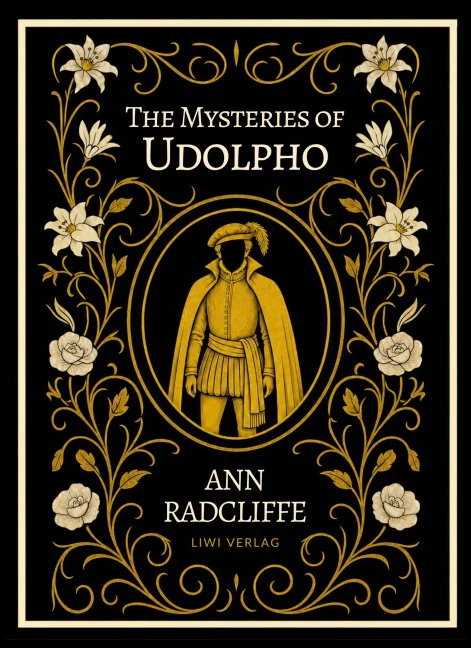
The Mysteries of Udolpho
In The Mysteries of Udolpho, Ann Radcliffe created one of the defining works of Gothic fiction: a novel of dark castles, hidden chambers, sublime landscapes, sinister threats, and mysteries that seem to belong to the supernatural.
At its center is Emily St. Aubert, a young woman drawn into the power of the ruthless Montoni and carried to the remote castle of Udolpho.
Behind its locked doors and shadowed corridors, strange sounds, unexplained events, and terrifying discoveries test both her courage and her reason.
First published in 1794, the novel became a landmark of Gothic literature and helped shape the genre for generations.
Buch bestellen
(Anzeige / Affiliatelink)*



 Jane Austen made Udolpho a central point of reference in Northanger Abbey, while its influence can also be traced in the works of Edgar Allan Poe and Herman Melville.
More than two centuries later, The Mysteries of Udolpho still fascinates because Radcliffe understood that terror is often strongest before it is explained: in the half-seen figure, the closed door, the distant sound, and the fear of what may be waiting in the dark.
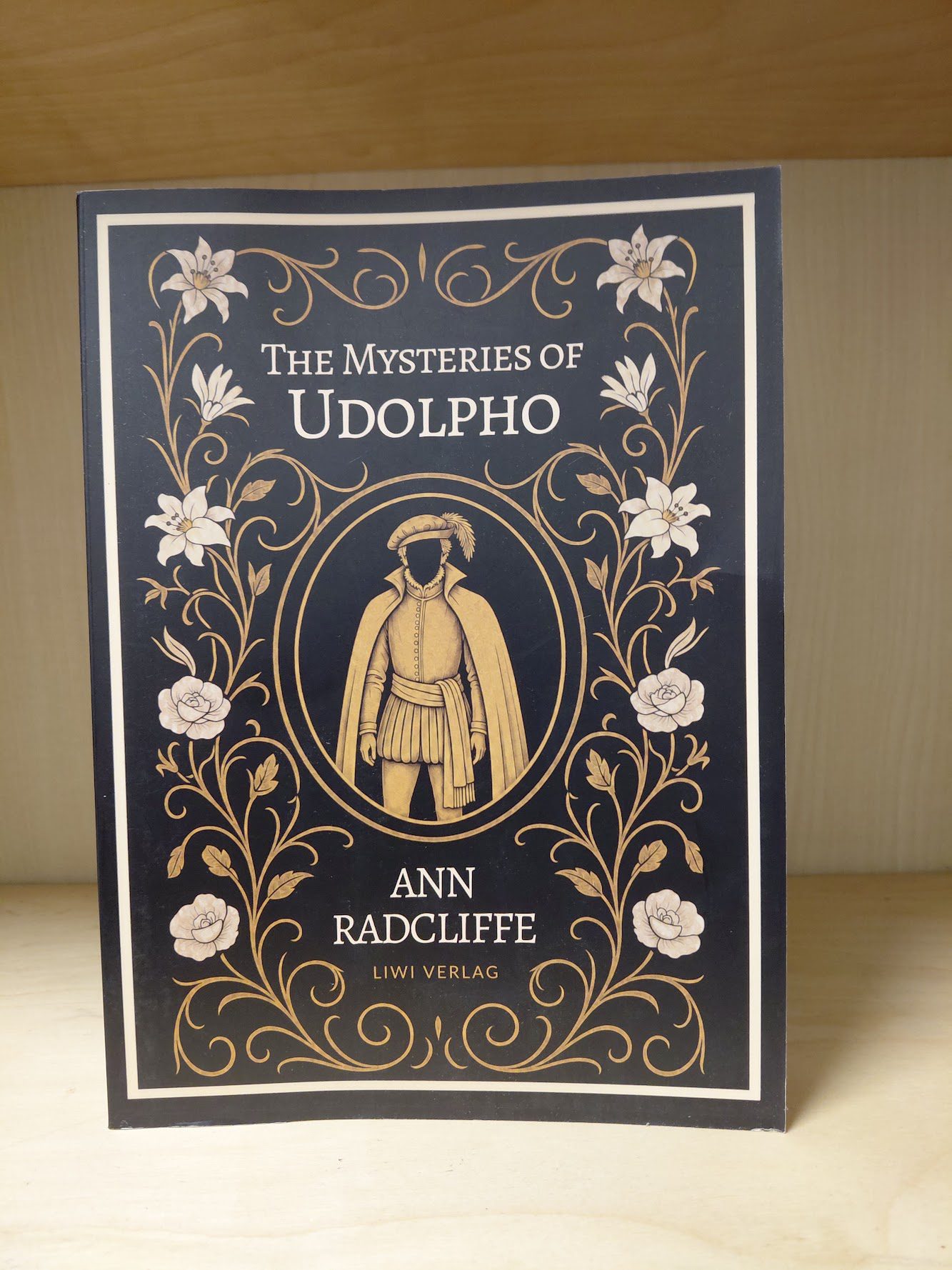
This is the English-language paperback edition of the classic novel, based on the original 1794 text.
Ann Radcliffe. The Mysteries of Udolpho. A Romance. First published as: The Mysteries of Udolpho, A Romance; Interspersed with Some Pieces of Poetry. G. G. and J. Robinson, London, 1794. The original British spelling has been retained; obvious typographical errors have been corrected. New edition, Göttingen, 2026.
EAN: 9783753805054
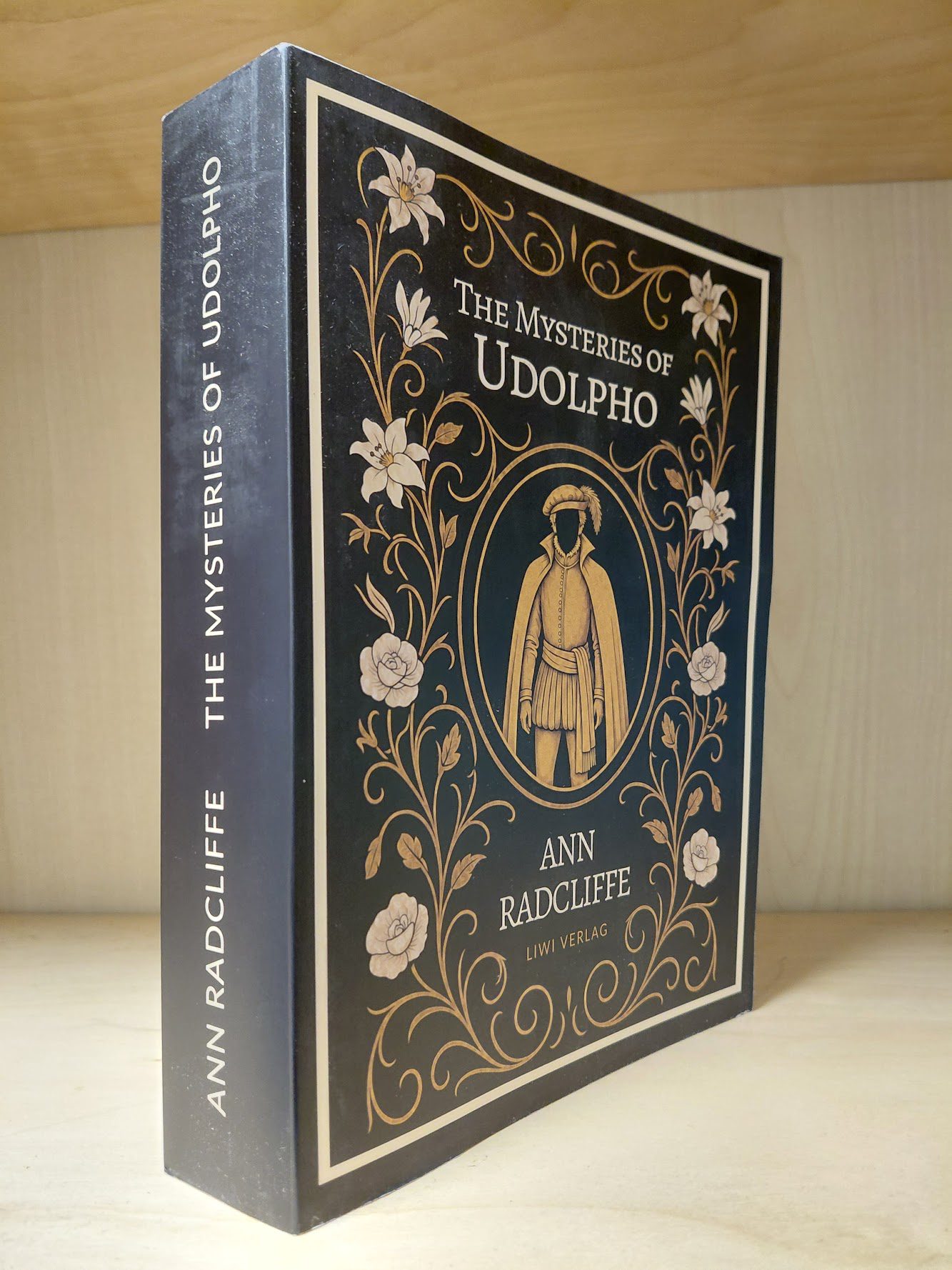
The Gothic Masterpiece That Shaped Generations of Mystery and Horror. Sprachen: Englisch. 22,0 cm / 16,0 cm / 4,0 cm ( B/H/T )
LIWI Literatur- und Wissenschaftsverlag
August 2026 – 580 Seiten
Buch bestellen
(Anzeige / Affiliatelink)*
The Mysteries of Udolpho – Overview: Key Facts at a Glance
- Author: Ann Radcliffe
- Genre: Gothic novel
- Publication: 8 May 1794, in four volumes
- Literary period: Romanticism; late 18th-century Gothic fiction
- Setting: France and Italy in the 1580s, especially Gascony, the Pyrenees, Toulouse, Venice, the Castle of Udolpho and Languedoc
- Major characters: Emily St. Aubert, Valancourt, Montoni, Madame Cheron/Madame Montoni, Annette, Ludovico, Count Morano and Signora Laurentini di Udolpho
- Central themes: Fear and the supernatural, reason and superstition, love and virtue, isolation, oppression, inheritance, female independence, nature and the sublime
- Plot in one sentence: After losing her parents, Emily St. Aubert falls under the control of the sinister Montoni and is imprisoned in the remote Castle of Udolpho, where she must endure threats, apparent supernatural horrors and family secrets before escaping and being reunited with Valancourt.
Famous Quotes
“A well-informed mind is the best security against the contagion of folly and of vice. The vacant mind is ever on the watch for relief, and ready to plunge into error, to escape from the languor of idleness. Store it with ideas, teach it the pleasure of thinking; and the temptations of the world without, will be counteracted by the gratifications derived from the world within.”
Chapter I, p. 11 of the LIWI edition
“I live for my family and myself; I am now contented to know only happiness;—formerly I knew life.”
Chapter I, p. 17
“Virtue and taste are nearly the same, for virtue is little more than active taste, and the most delicate affections of each combine in real love. How then are we to look for love in great cities, where selfishness, dissipation, and insincerity supply the place of tenderness, simplicity and truth?”
Chapter V, p. 49
“Poverty cannot deprive us of many consolations. It cannot rob us of the affection we have for each other, or degrade us in our own opinion, or in that of any person, whose opinion we ought to value.”
Chapter VI, p. 57
“We become the victims of our feelings, unless we can in some degree command them.”
Chapter VII, p. 75
“Happiness arises in a state of peace, not of tumult.”
Chapter VII, p. 75
“Such is the inconsistency of real love, that it is always awake to suspicion, however unreasonable; always requiring new assurances from the object of its interest.”
Chapter XIII, p. 137
“You may find, perhaps, Signor, that the strength of my mind is equal to the justice of my cause; and that I can endure with fortitude, when it is in resistance of oppression.”
Chapter XXX, p. 330
“You speak like a heroine,” said Montoni, contemptuously; “we shall see whether you can suffer like one.”
Chapter XXX, p. 330
“O! useful may it be to have shown, that, though the vicious can sometimes pour affliction upon the good, their power is transient and their punishment certain; and that innocence, though oppressed by injustice, shall, supported by patience, finally triumph over misfortune!”
Chapter LVII, p. 577
“And, if the weak hand, that has recorded this tale, has, by its scenes, beguiled the mourner of one hour of sorrow, or, by its moral, taught him to sustain it—the effort, however humble, has not been vain, nor is the writer unrewarded.”
Chapter LVII, p. 577
Buch bestellen
(Anzeige / Affiliatelink)*
Verfasst von Thomas Löding, LIWI Blog, zuletzt aktualisiert am 05. Januar 2026
Buchempfehlungen – Listen zum Stöbern:
- Buchempfehlungen: Die besten Bücher aller Zeiten
- 100 Bücher – Die neue ZEIT-Bibliothek der Weltliteratur
- Lieblingsbücher der Briten: BBC Big Read
- Die 100 Bücher des Jahrhunderts von Le Monde
- Der Kanon: Die deutsche Literatur. Reich-Ranickis Liste
- Liste der 100 besten englischsprachigen Romane
- Die besten Bücher von Frauen – Die Kanon – Sybille Berg
- Die besten Bücher 2024
- Liste der 100 besten englischsprachigen Romane
- Die Zeit Bibliothek der 100 Bücher (1980)
- BBC-Auswahl der 100 bedeutendsten britischen Romane
- Schecks Kanon – Die 100 wichtigsten Werke der Weltliteratur
- BBC-Auswahl der 20 besten Romane von 2000 bis 2014
- Elke Heidenreich: Buchtipps & Lieblingsbücher
- Christine Westermann Buchtipps
- Das Literarische Quartett Bücherliste
„Die besten Bücher“ – Auswahl des LIWI Blogs:
- Die besten Bücher von Edgar Allan Poe
- Die besten Bücher von Stefan Zweig
- Die besten Bücher von Fjodor Dostojewski
- Die besten Bücher von Franz Kafka
- Die besten Bücher von Jack London
- Die besten Bücher von Heinrich Heine
- Die besten Bücher von E. T. A. Hoffmann
- Die besten Bücher von Daniel Defoe
- Die besten Bücher von Heinrich Mann
- Die besten Bücher von Joseph Roth
- Die besten Bücher von Rudyard Kipling
- Die besten Bücher von Eduard von Keyserling
- Die besten Bücher von Else Lasker-Schüler
- Die besten Bücher von Arthur Schnitzler
- Die besten Bücher von Gustave Flaubert
- Die besten Bücher von Hans Fallada
- Die besten Bücher von Joseph Conrad
- Die besten Bücher von Novalis
- Die besten historischen Romane
- Die besten Bücher gegen Rechts
- Die besten Bücher für den Sommer
- Die besten Kinderbücher
- Die besten Gedichte von Rainer Maria Rilke
- Die wichtigsten Literaturepochen
- Was ist ein Klassiker?
„Literaturpreis – Gewinner“: