
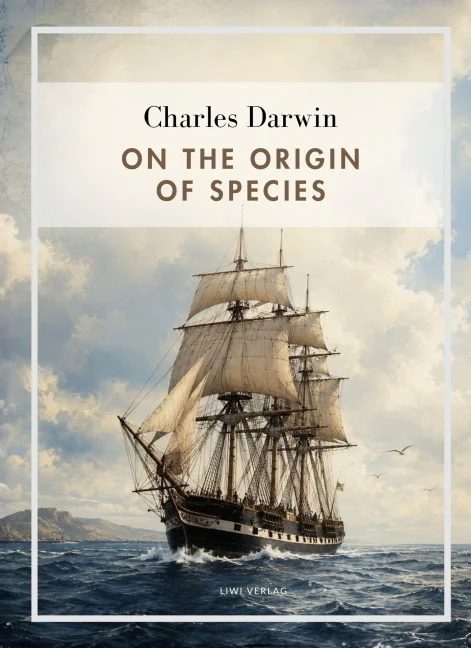
On the Origin of Species
Why do species change? How do complex forms of life arise? And why are some organisms better adapted to their environment than others?
In On the Origin of Species, Charles Darwin offers a powerful answer: over many generations, natural selection preserves advantageous variations and shapes the diversity of life. First published in 1859, the book revolutionised biological thought and permanently transformed our understanding of the natural world.
Darwin’s argument reshaped science, provoked intense religious and philosophical debate, and changed humanity’s perception of its relationship to all other forms of life. Combining rigorous evidence with vivid description and an enduring fascination with nature, he created a scientific classic whose influence continues to be felt today.
Buch bestellen
(Anzeige / Affiliatelink)*



Charles Darwin. On the Origin of Species by Means of Natural Selection, or the Preservation of Favoured Races in the Struggle for Life. First published as: On the Origin of Species by Means of Natural Selection, or the Preservation of Favoured Races in the Struggle for Life. John Murray, London, 1859. The text of this edition is based substantially on the sixth edition, published by John Murray, London, in 1872, the final edition extensively revised by Charles Darwin. New edition, Göttingen, 2026.
EAN: 9783753804910
The Revolutionary Work That Changed Our Understanding of Life. Sprachen: Englisch. 22,0 cm / 16,0 cm / 2,7 cm ( B/H/T )
LIWI Literatur- und Wissenschaftsverlag
Juli 2026 – 424 Seiten
Buch bestellen
(Anzeige / Affiliatelink)*
Famous Quotes
“Nothing is easier than to admit in words the truth of the universal struggle for life, or more difficult—at least I found it so—than constantly to bear this conclusion in mind.”
Chapter III: Struggle for Existence, p. 61 of the LIWI edition
“A struggle for existence inevitably follows from the high rate at which all organic beings tend to increase.”
Chapter III: Struggle for Existence, p. 62
“This preservation of favourable individual differences and variations, and the destruction of those which are injurious, I have called Natural Selection, or the Survival of the Fittest.”
Chapter IV: Natural Selection; or the Survival of the Fittest, p. 73
“It may metaphorically be said that natural selection is daily and hourly scrutinising, throughout the world, the slightest variations; rejecting those that are bad, preserving and adding up all that are good; silently and insensibly working, whenever and wherever opportunity offers, at the improvement of each organic being in relation to its organic and inorganic conditions of life.”
Chapter IV: Natural Selection; or the Survival of the Fittest, p. 76
“If it could be demonstrated that any complex organ existed, which could not possibly have been formed by numerous, successive, slight modifications, my theory would absolutely break down. But I can find out no such case.”
Chapter VI, p. 150
“It is interesting to contemplate a tangled bank, clothed with many plants of many kinds, with birds singing on the bushes, with various insects flitting about, and with worms crawling through the damp earth, and to reflect that these elaborately constructed forms, so different from each other, and dependent upon each other in so complex a manner, have all been produced by laws acting around us.”
Chapter XV, p. 400
“There is grandeur in this view of life, with its several powers, having been originally breathed by the Creator into a few forms or into one; and that, whilst this planet has gone circling on according to the fixed law of gravity, from so simple a beginning endless forms most beautiful and most wonderful have been, and are being evolved.”
Chapter XV, p. 400
Buch bestellen
(Anzeige / Affiliatelink)*
Verfasst von Thomas Löding, LIWI Blog, zuletzt aktualisiert am 05. Januar 2026
Buchempfehlungen – Listen zum Stöbern:
- Buchempfehlungen: Die besten Bücher aller Zeiten
- 100 Bücher – Die neue ZEIT-Bibliothek der Weltliteratur
- Lieblingsbücher der Briten: BBC Big Read
- Die 100 Bücher des Jahrhunderts von Le Monde
- Der Kanon: Die deutsche Literatur. Reich-Ranickis Liste
- Liste der 100 besten englischsprachigen Romane
- Die besten Bücher von Frauen – Die Kanon – Sybille Berg
- Die besten Bücher 2024
- Liste der 100 besten englischsprachigen Romane
- Die Zeit Bibliothek der 100 Bücher (1980)
- BBC-Auswahl der 100 bedeutendsten britischen Romane
- Schecks Kanon – Die 100 wichtigsten Werke der Weltliteratur
- BBC-Auswahl der 20 besten Romane von 2000 bis 2014
- Elke Heidenreich: Buchtipps & Lieblingsbücher
- Christine Westermann Buchtipps
- Das Literarische Quartett Bücherliste
„Die besten Bücher“ – Auswahl des LIWI Blogs:
- Die besten Bücher von Edgar Allan Poe
- Die besten Bücher von Stefan Zweig
- Die besten Bücher von Fjodor Dostojewski
- Die besten Bücher von Franz Kafka
- Die besten Bücher von Jack London
- Die besten Bücher von Heinrich Heine
- Die besten Bücher von E. T. A. Hoffmann
- Die besten Bücher von Daniel Defoe
- Die besten Bücher von Heinrich Mann
- Die besten Bücher von Joseph Roth
- Die besten Bücher von Rudyard Kipling
- Die besten Bücher von Eduard von Keyserling
- Die besten Bücher von Else Lasker-Schüler
- Die besten Bücher von Arthur Schnitzler
- Die besten Bücher von Gustave Flaubert
- Die besten Bücher von Hans Fallada
- Die besten Bücher von Joseph Conrad
- Die besten Bücher von Novalis
- Die besten historischen Romane
- Die besten Bücher gegen Rechts
- Die besten Bücher für den Sommer
- Die besten Kinderbücher
- Die besten Gedichte von Rainer Maria Rilke
- Die wichtigsten Literaturepochen
- Was ist ein Klassiker?
„Literaturpreis – Gewinner“: