
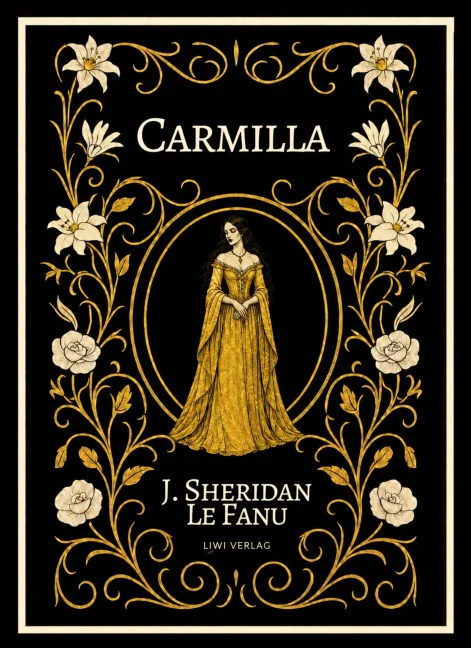
Carmilla
In a secluded castle in nineteenth-century Styria, young Laura leads a quiet and sheltered life-until a mysterious carriage accident brings the beautiful Carmilla into her home.
From the moment they meet, the two women are drawn to one another with an intimacy that is both irresistible and unsettling.
But as Carmilla’s presence grows more intense, Laura begins to suffer from strange dreams, mysterious weakness, and the terrifying sense that something is visiting her in the night.
First published in 1871-72, Carmilla is one of the foundational works of vampire literature and a major influence on Bram Stoker’s Dracula.
Long before Dracula entered his Transylvanian castle, Sheridan Le Fanu had already shaped many of the themes and conventions that would define the modern vampire tale.
Buch bestellen
(Anzeige / Affiliatelink)*



At the heart of the novella lies the ambiguous relationship between Laura and Carmilla.
Their mutual attraction is unmistakable, yet-as was characteristic of Victorian literature-its lesbian dimension is suggested through gestures, embraces, jealousy, longing, and coded language rather than stated explicitly.
A landmark of Gothic fiction, Carmilla is at once a vampire story, a tale of forbidden intimacy, and a haunting exploration of desire that cannot openly speak its name.
Joseph Sheridan Le Fanu. Carmilla. Originally serialized in The Dark Blue, London, 1871-1872. First published in book form in In a Glass Darkly, Richard Bentley and Son, London, 1872. The text of this edition is based substantially on the original 1872 book edition. The original British spelling has been retained; obvious typographical errors have been corrected. New edition, Göttingen, 2026.
EAN: 9783753805016
The Gothic Vampire Classic That Inspired Bram Stoker’s Dracula. Sprachen: Englisch. 22,0 cm / 16,0 cm / 0,5 cm ( B/H/T )
LIWI Literatur- und Wissenschaftsverlag
August 2026 – 68 Seiten
Buch bestellen
(Anzeige / Affiliatelink)*
Carmilla – Overview: Key Facts at a Glance
- Author: Joseph Sheridan Le Fanu
- Genre: Gothic novella, horror fiction, vampire literature
- Publication: 1871–1872 as a serial in The Dark Blue; collected in In a Glass Darkly in 1872
- Literary period: Victorian literature; 19th-century Gothic fiction
- Setting: Styria in the Austrian Empire, in the 19th century, primarily at Laura’s secluded family castle and the nearby ruins of Karnstein
- Major characters: Laura, Carmilla (Mircalla, Countess Karnstein), Laura’s father, General Spielsdorf, Bertha Rheinfeldt and Baron Vordenburg
- Central themes: Vampirism and the supernatural, desire and repression, attraction and repulsion, female intimacy, innocence and corruption, identity, death and the conflict between reason and superstition
- Plot in one sentence: The isolated young Laura forms an intense and unsettling bond with the mysterious Carmilla, only to discover that her companion is an ancient vampire who has been preying on young women in the region.
Famous Quotes
“You are mine, you shall be mine, you and I are one for ever.”
Chapter IV, p. 23 of the LIWI edition
“I was conscious of a love growing into adoration, and also of abhorrence. This I know is paradox, but I can make no other attempt to explain the feeling.”
Chapter IV, p. 23
“In the rapture of my enormous humiliation I live in your warm life, and you shall die—die, sweetly die—into mine.”
Chapter IV, p. 23
“I cannot help it; as I draw near to you, you, in your turn, will draw near to others, and learn the rapture of that cruelty, which yet is love.”
Chapter IV, p. 23
“But to die as lovers may—to die together, so that they may live together.”
Chapter IV, p. 28
“I have been in love with no one, and never shall, unless it should be with you.”
Chapter V, p. 31
“You will think me cruel, very selfish, but love is always selfish; the more ardent the more selfish.”
Chapter VI, p. 33
“You must come with me, loving me, to death; or else hate me and still come with me, and hating me through death and after.”
Chapter VI, p. 33
“There is no such word as indifference in my apathetic nature.”
Chapter VI, p. 33
“But dreams come through stone walls, light up dark rooms, or darken light ones, and their persons make their exits and their entrances as they please, and laugh at locksmiths.”
Chapter VI, p. 34
“The amphibious existence of the vampire is sustained by daily renewed slumber in the grave. Its horrible lust for living blood supplies the vigour of its waking existence.”
Chapter XVI, p. 65
“The vampire is prone to be fascinated with an engrossing vehemence, resembling the passion of love, by particular persons.”
Chapter XVI, pp. 65–66
Buch bestellen
(Anzeige / Affiliatelink)*
Verfasst von Thomas Löding, LIWI Blog, zuletzt aktualisiert am 05. Januar 2026
Buchempfehlungen – Listen zum Stöbern:
- Buchempfehlungen: Die besten Bücher aller Zeiten
- 100 Bücher – Die neue ZEIT-Bibliothek der Weltliteratur
- Lieblingsbücher der Briten: BBC Big Read
- Die 100 Bücher des Jahrhunderts von Le Monde
- Der Kanon: Die deutsche Literatur. Reich-Ranickis Liste
- Liste der 100 besten englischsprachigen Romane
- Die besten Bücher von Frauen – Die Kanon – Sybille Berg
- Die besten Bücher 2024
- Liste der 100 besten englischsprachigen Romane
- Die Zeit Bibliothek der 100 Bücher (1980)
- BBC-Auswahl der 100 bedeutendsten britischen Romane
- Schecks Kanon – Die 100 wichtigsten Werke der Weltliteratur
- BBC-Auswahl der 20 besten Romane von 2000 bis 2014
- Elke Heidenreich: Buchtipps & Lieblingsbücher
- Christine Westermann Buchtipps
- Das Literarische Quartett Bücherliste
„Die besten Bücher“ – Auswahl des LIWI Blogs:
- Die besten Bücher von Edgar Allan Poe
- Die besten Bücher von Stefan Zweig
- Die besten Bücher von Fjodor Dostojewski
- Die besten Bücher von Franz Kafka
- Die besten Bücher von Jack London
- Die besten Bücher von Heinrich Heine
- Die besten Bücher von E. T. A. Hoffmann
- Die besten Bücher von Daniel Defoe
- Die besten Bücher von Heinrich Mann
- Die besten Bücher von Joseph Roth
- Die besten Bücher von Rudyard Kipling
- Die besten Bücher von Eduard von Keyserling
- Die besten Bücher von Else Lasker-Schüler
- Die besten Bücher von Arthur Schnitzler
- Die besten Bücher von Gustave Flaubert
- Die besten Bücher von Hans Fallada
- Die besten Bücher von Joseph Conrad
- Die besten Bücher von Novalis
- Die besten historischen Romane
- Die besten Bücher gegen Rechts
- Die besten Bücher für den Sommer
- Die besten Kinderbücher
- Die besten Gedichte von Rainer Maria Rilke
- Die wichtigsten Literaturepochen
- Was ist ein Klassiker?
„Literaturpreis – Gewinner“: