
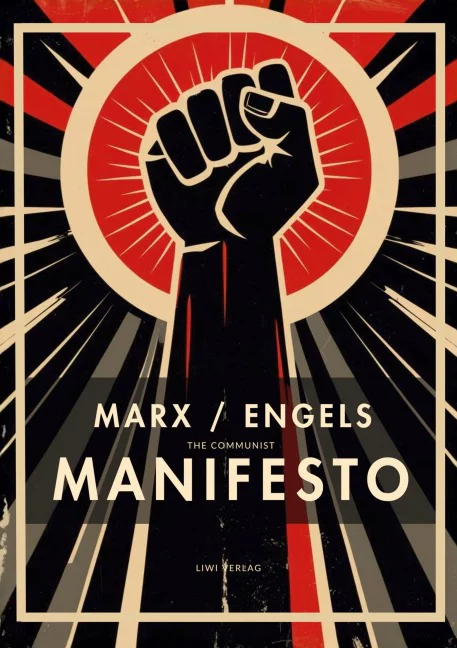
The Communist Manifesto (English Edition)
First published in 1848, „The Communist Manifesto“ not only shaped the labor movement of the 19th and 20th centuries, but also became a central point of reference for left-wing theories and political movements around the world.
In clear and forceful language, Marx and Engels examine social class relations and articulate their vision of a classless, communist society.
Karl Marx / Friedrich Engels.
The Communist Manifesto. Erstdruck in deutscher Sprache (First published in German): Manifest der Kommunistischen Partei. Office der Bildungs-Gesellschaft für Arbeiter von J. E. Burghard, London 1848. Autorisierte englische Übersetzung, herausgegeben und kommentiert von Friedrich Engels, 1888. (Authorized English Translation, edited and annotated by Friedrich Engels, 1888.)
Buch bestellen
(Anzeige / Affiliatelink)*



Durchgesehener Neusatz; der Text dieser Ausgabe folgt (Revised typesetting;t his edition follows the text of): Manifesto of the Communist Party, Labor News Co., New York 1908.
ISBN: 9783753801964
November 2025 – 56 Seiten
Vollständige Neuausgabe, Göttingen 2025 (Complete new edition, Göttingen 2025)
Buch bestellen
(Anzeige / Affiliatelink)*
Famous Quotes
“A specter is haunting Europe—the specter of Communism.”
Manifesto, p. 13 of the LIWI edition
“The history of all hitherto existing society is the history of class struggles.”
Chapter I “Bourgeois and Proletarians”, p. 14
“The executive of the modern State is but a committee for managing the common affairs of the whole bourgeoisie.”
Chapter I “Bourgeois and Proletarians”, p. 16
“The bourgeoisie, wherever it has got the upper hand, has put an end to all feudal, patriarchal, idyllic relations.”
Chapter I “Bourgeois and Proletarians”, p. 16
“All that is solid melts into air, all that is holy is profaned, and man is at last compelled to face with sober senses his real conditions of life and his relations with his kind.”
Chapter I “Bourgeois and Proletarians”, p. 17
“National one-sidedness and narrow-mindedness become more and more impossible, and from the numerous national and local literatures, there arises a world literature.”
Chapter I “Bourgeois and Proletarians”, p. 18
“In one word, it creates a world after its own image.”
Chapter I “Bourgeois and Proletarians”, p. 19
“But every class struggle is a political struggle.”
Chapter I “Bourgeois and Proletarians”, p. 25
“What the bourgeoisie therefore produces, above all, are its own grave diggers. Its fall and the victory of the proletariat are equally inevitable.”
Chapter I “Bourgeois and Proletarians”, p. 29
“In this sense the theory of the Communists may be summed up in the single sentence: Abolition of private property.”
Chapter II “Proletarians and Communists”, p. 31
“Capital is therefore not a personal, it is a social power.”
Chapter II “Proletarians and Communists”, p. 32
“The workingmen have no country. We cannot take from them what they have not got.”
Chapter II “Proletarians and Communists”, p. 37
“The ruling ideas of each age have ever been the ideas of its ruling class.”
Chapter II “Proletarians and Communists”, p. 38
“The Communists disdain to conceal their views and aims. They openly declare that their ends can be attained only by the forcible overthrow of all existing social conditions.”
Chapter IV “Position of the Communists”, p. 56
“Let the ruling classes tremble at a Communistic revolution. The proletarians have nothing to lose but their chains. They have a world to win. Workingmen of all countries unite!”
Chapter IV “Position of the Communists”, p. 56
Buch bestellen
(Anzeige / Affiliatelink)*
Verfasst von Thomas Löding, LIWI Blog, zuletzt aktualisiert am 05. Januar 2026
Buchempfehlungen – Listen zum Stöbern:
- Buchempfehlungen: Die besten Bücher aller Zeiten
- 100 Bücher – Die neue ZEIT-Bibliothek der Weltliteratur
- Lieblingsbücher der Briten: BBC Big Read
- Die 100 Bücher des Jahrhunderts von Le Monde
- Der Kanon: Die deutsche Literatur. Reich-Ranickis Liste
- Liste der 100 besten englischsprachigen Romane
- Die besten Bücher von Frauen – Die Kanon – Sybille Berg
- Die besten Bücher 2024
- Liste der 100 besten englischsprachigen Romane
- Die Zeit Bibliothek der 100 Bücher (1980)
- BBC-Auswahl der 100 bedeutendsten britischen Romane
- Schecks Kanon – Die 100 wichtigsten Werke der Weltliteratur
- BBC-Auswahl der 20 besten Romane von 2000 bis 2014
- Elke Heidenreich: Buchtipps & Lieblingsbücher
- Christine Westermann Buchtipps
- Das Literarische Quartett Bücherliste
„Die besten Bücher“ – Auswahl des LIWI Blogs:
- Die besten Bücher von Edgar Allan Poe
- Die besten Bücher von Stefan Zweig
- Die besten Bücher von Fjodor Dostojewski
- Die besten Bücher von Franz Kafka
- Die besten Bücher von Jack London
- Die besten Bücher von Heinrich Heine
- Die besten Bücher von E. T. A. Hoffmann
- Die besten Bücher von Daniel Defoe
- Die besten Bücher von Heinrich Mann
- Die besten Bücher von Joseph Roth
- Die besten Bücher von Rudyard Kipling
- Die besten Bücher von Eduard von Keyserling
- Die besten Bücher von Else Lasker-Schüler
- Die besten Bücher von Arthur Schnitzler
- Die besten Bücher von Gustave Flaubert
- Die besten Bücher von Hans Fallada
- Die besten Bücher von Joseph Conrad
- Die besten Bücher von Novalis
- Die besten historischen Romane
- Die besten Bücher gegen Rechts
- Die besten Bücher für den Sommer
- Die besten Kinderbücher
- Die besten Gedichte von Rainer Maria Rilke
- Die wichtigsten Literaturepochen
- Was ist ein Klassiker?
„Literaturpreis – Gewinner“: