
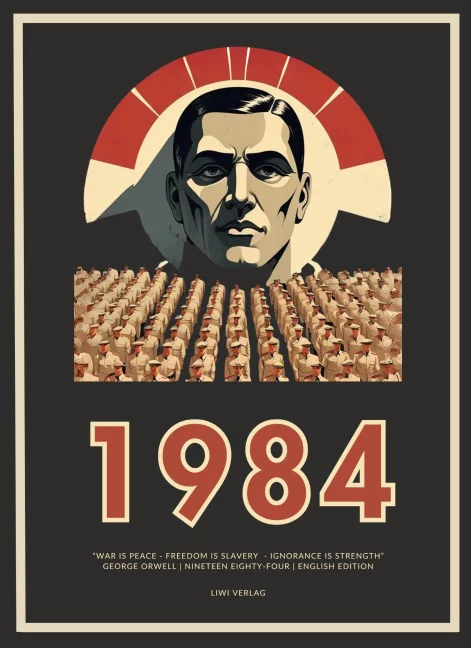
1984 / Nineteen Eighty-Four (English Edition)
George Orwell’s „1984“ (first published in 1949) is a groundbreaking dystopian novel set in a totalitarian society ruled by the oppressive Party and its leader, Big Brother.
The story follows Winston Smith, a low-ranking Party member who secretly rebels against the regime’s pervasive surveillance, propaganda, and thought control.
Through concepts like Newspeak, doublethink, and the infamous slogan „War is Peace, Freedom is Slavery, Ignorance is Strength,“ Orwell explores themes of government overreach, psychological manipulation, and the erosion of truth.
„1984“ remains a chilling and influential critique of authoritarianism, still widely studied and referenced today.
This edition is the English-language paperback version of Orwell’s classic novel.
George Orwell. 1984. First published: „Nineteen Eighty-Four“, Secker and Warburg, London 1949.
ISBN: 9783753800080
Juni 2025 – 184 Seiten
Neuausgabe, LIWI Literatur- und Wissenschaftsverlag, Göttingen 2025.
Buch bestellen
(Anzeige / Affiliatelink)*



1984 – Influences
Among the major literary and political influences on 1984 are
 Yevgeny Zamyatin’s We,
Aldous Huxley’s Brave New World,
Arthur Koestler’s Darkness at Noon and The Yogi and the Commissar,
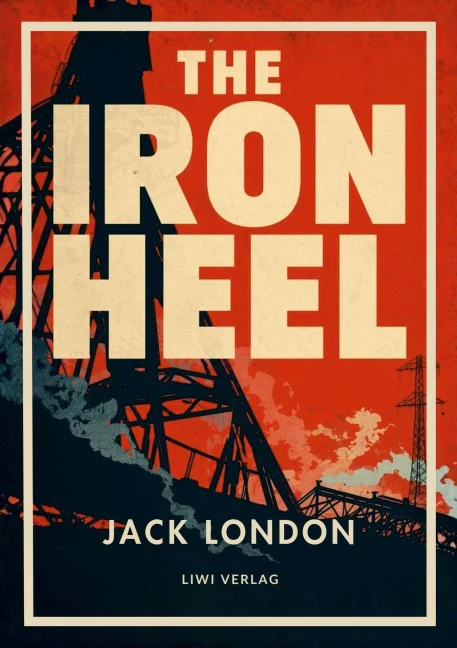
Jack London’s The Iron Heel,
James Burnham’s The Managerial Revolution,
H. G. Wells’s A Modern Utopia, and
Jorge Luis Borges’s Tlön, Uqbar, Orbis Tertius.
At the same time, Orwell drew on his own experiences in the Spanish Civil War, his work at the BBC, and his reflections on Stalinism, propaganda, censorship, and the manipulation of language to create the novel’s haunting vision of totalitarian power, which remains so striking to this day.
Buch bestellen
(Anzeige / Affiliatelink)*
1984 – Themes
Nationalism
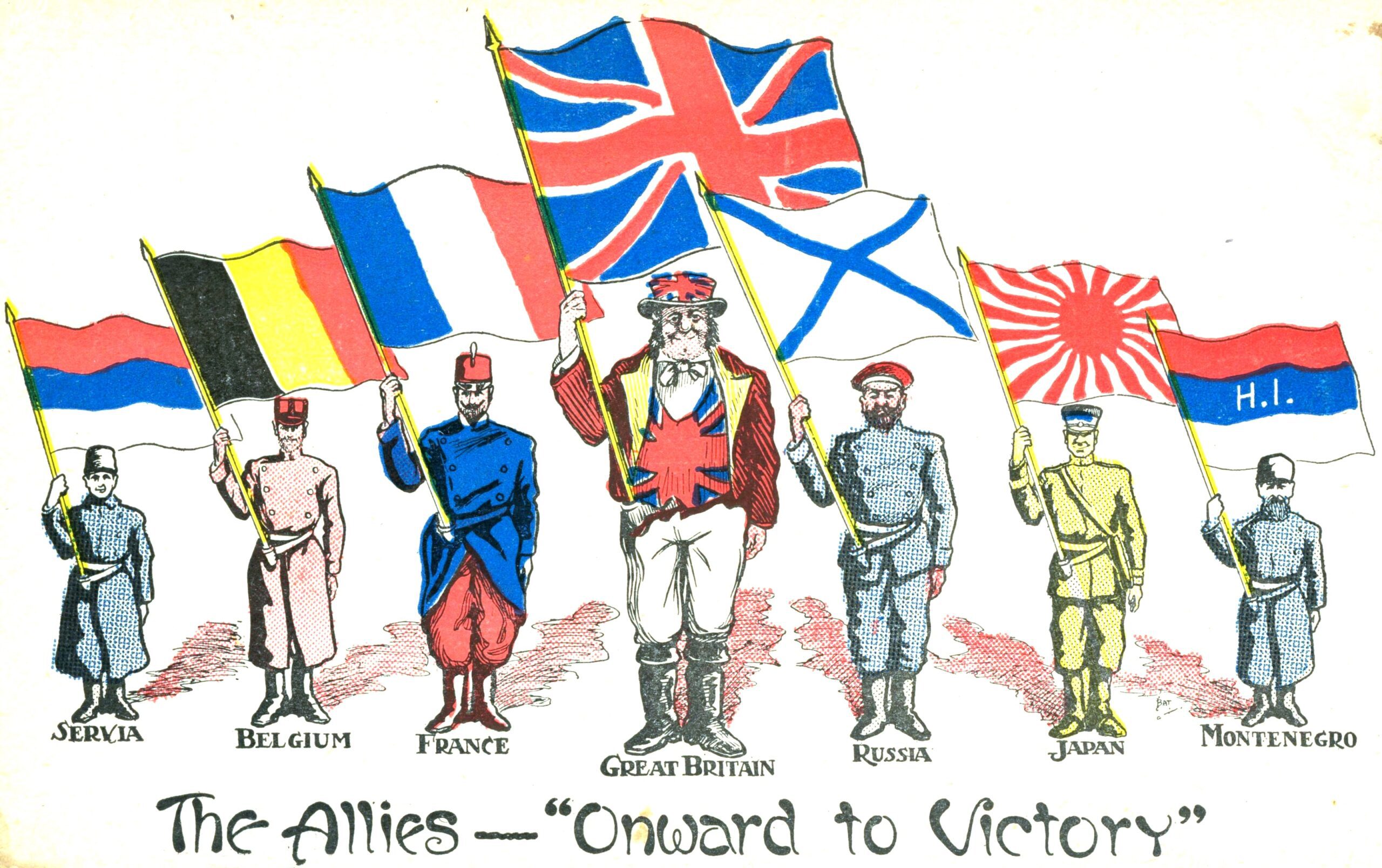 In Nineteen Eighty-Four, nationalism is not presented simply as patriotism or love of country. Instead, Orwell shows it as a manufactured emotional force that can be directed wherever the Party wishes.
The Party demands absolute devotion to Big Brother and, at the same time, absolute hatred toward the enemy of the moment. What matters is not truth, consistency, or reason, but intensity of feeling.
This is why the sudden shift of hatred from one enemy to another is so important. When the Party changes its official enemy, the population adjusts at once, as if nothing had happened. Orwell reveals that in a totalitarian society, loyalty is unstable, memory is controlled, and public emotion is politically engineered.
In this sense, nationalism in the novel becomes a tool of power. It binds people together not through genuine shared belief, but through collective submission, emotional manipulation, and ritualized hostility.
Futurology
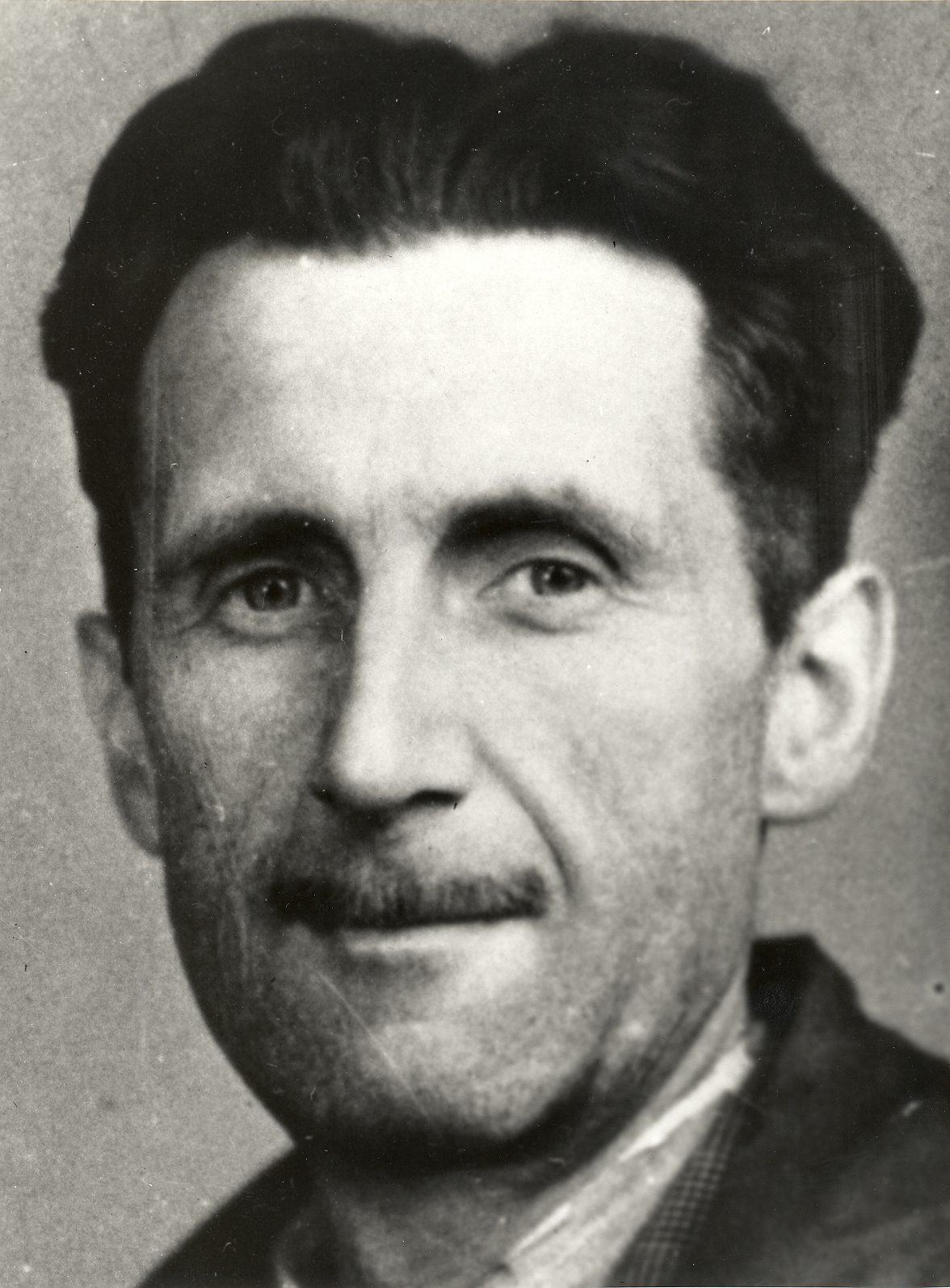 Orwell’s future is not a world of liberation, innovation, or human improvement. It is a vision of endless domination.
The Party does not claim power in order to create justice, prosperity, or peace. Its real goal is simply to preserve and expand power itself. This is one of the darkest insights of the novel.
In O’Brien’s description of the future, all competing pleasures, freedoms, and loyalties are to be eliminated. There will be no space for curiosity, love, privacy, or joy if these things threaten the authority of the state.
The result is a future in which power has become an end in itself. Orwell’s warning is therefore not only political but existential: he imagines a society in which the human person is no longer valued except as something to be disciplined, broken, and ruled.
Buch bestellen
(Anzeige / Affiliatelink)*
Censorship
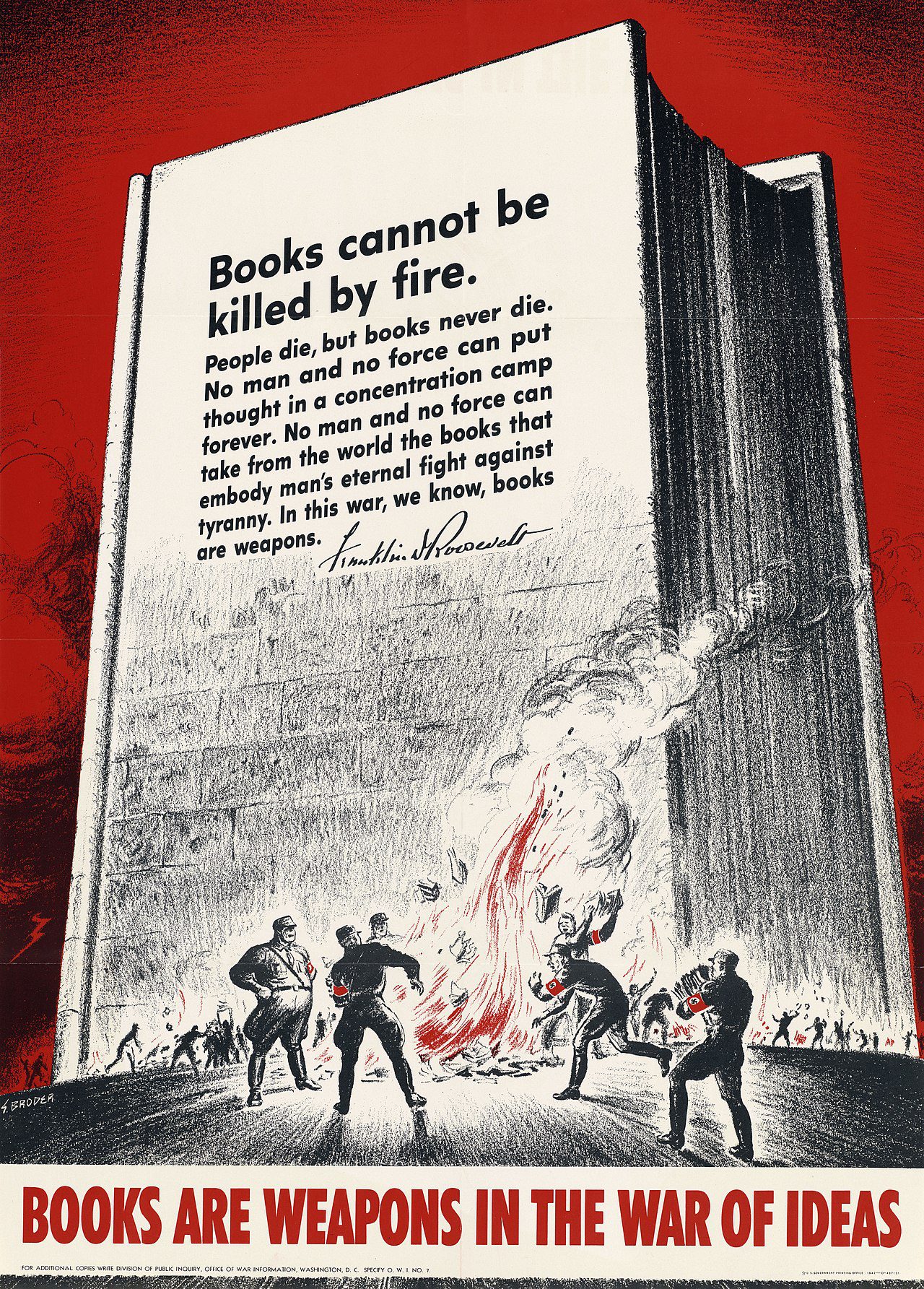 One of the most striking features of the novel is its portrayal of total censorship. In Oceania, censorship does not merely suppress unwanted information; it actively rewrites the past.
At the Ministry of Truth, newspapers, archives, photographs, and official records are constantly altered so that they always support the Party’s current claims. If the Party changes its position, the historical record changes with it.
People who fall into disgrace do not simply disappear from public life. They become unpersons: individuals who are erased not only socially and politically, but also historically. It is as though they had never existed.
Orwell shows that this kind of censorship is more than propaganda. It is an attempt to control the very conditions under which truth can exist. Whoever controls memory, documents, and language can also control reality as it is publicly understood.
Surveillance
Oceania is a society built on constant surveillance. Citizens are watched in their homes, in their workplaces, and in public spaces, with almost no possibility of privacy.
The telescreen is the clearest symbol of this system. It does not merely broadcast propaganda; it also watches, listens, and reminds the individual that the state may be present at any moment.
This surveillance is reinforced by microphones, informers, and the Thought Police. Even ordinary people, including children, are drawn into the machinery of control and encouraged to report suspicious behaviour.
The real effect of surveillance is psychological. People do not merely fear punishment after disobedience; they begin to monitor themselves in advance. Orwell shows that the most effective tyranny is one in which external control becomes internalized obedience.
Poverty and Inequality
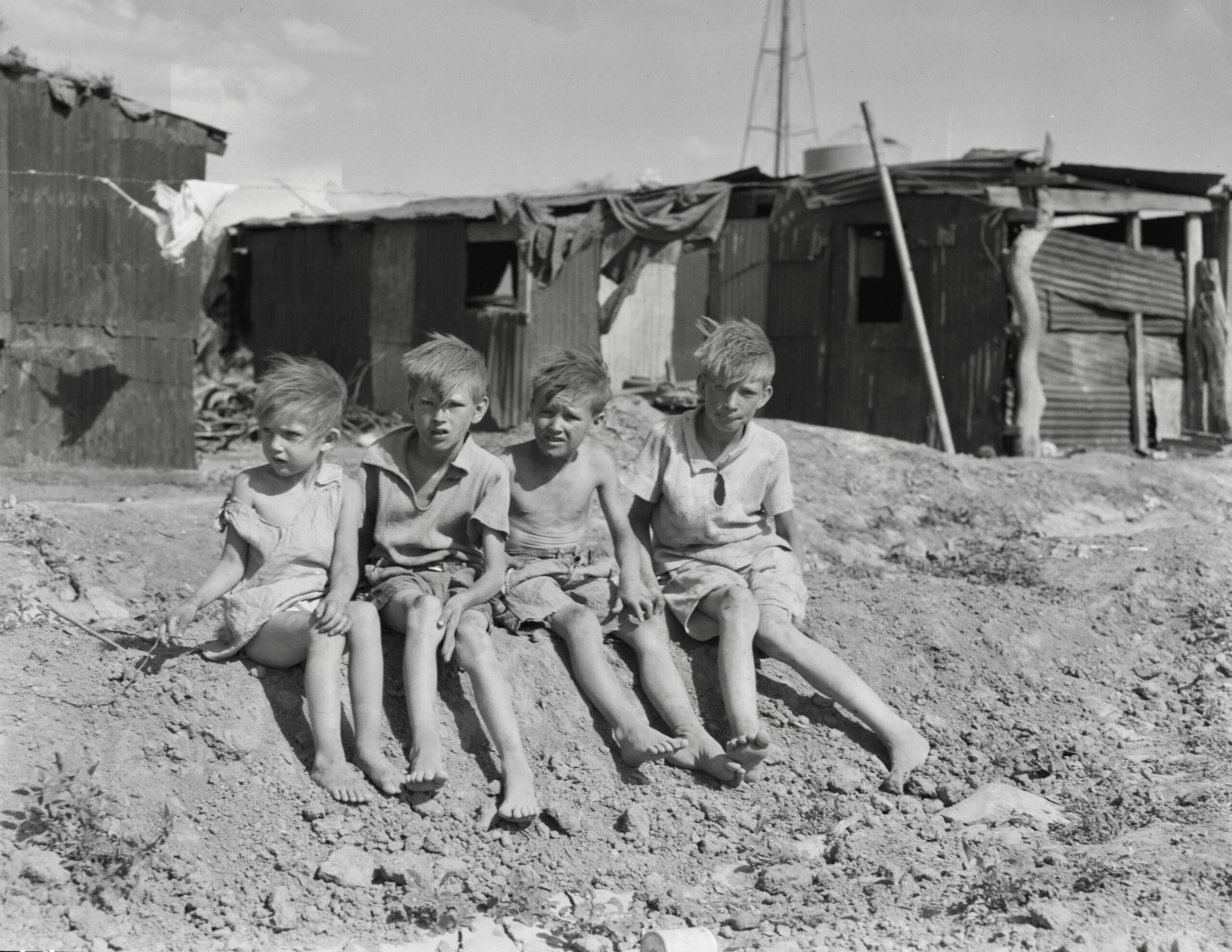
http://hdl.loc.gov/loc.pnp/fsa.8b15324
Although the Party constantly speaks in the language of success and achievement, the actual world of the novel is marked by poverty, decay, and deprivation.
Most people live among broken buildings, failing infrastructure, poor food, and cheap manufactured substitutes. Everyday life is dominated by shortage, discomfort, and the exhaustion of basic survival.
At the same time, Oceania is far from equal. The members of the Inner Party enjoy privileges denied to everyone else: better food, more comfortable homes, real luxury goods, and a degree of insulation from the misery surrounding them.
This contrast reveals an important truth about the regime: its claim to equality is fraudulent. The system depends on structured inequality, because poverty makes people weaker, more dependent, and easier to govern.
Orwell also suggests that scarcity itself serves a political purpose. A population kept in material insecurity is less able to think freely, organize resistance, or imagine a different life. In this sense, poverty is not just a condition of society; it is a method of rule.
Thought Control
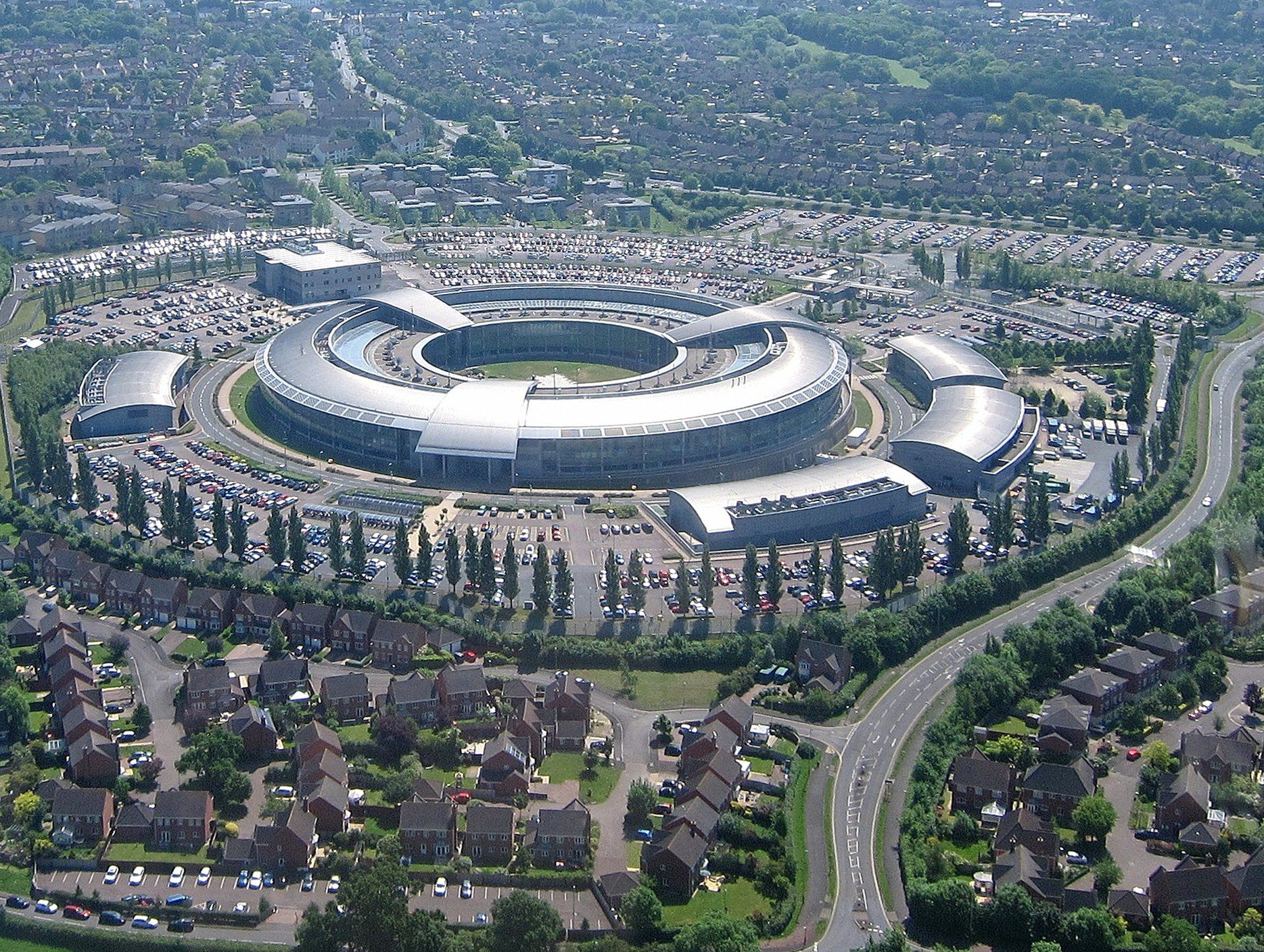 Perhaps the most terrifying aspect of the novel is that the Party does not stop at controlling behaviour. It wants to control the mind itself.
In Oceania, even the smallest outward sign of independent thought can be dangerous. A nervous gesture, an expression of doubt, or an involuntary reaction may be interpreted as evidence of disloyalty.
The concept of thoughtcrime makes clear that inward freedom is itself treated as a threat. It is not enough to obey outwardly; one must also think correctly, feel correctly, and perceive reality in the approved way.
This is what makes the regime so extreme. It rejects the idea that thoughts are private or morally distinct from actions. Instead, it tries to abolish the inner space in which judgment, memory, and conscience might still survive.
Orwell’s deepest warning lies here: totalitarianism reaches its final form when it no longer punishes only what people do, but seeks to destroy the very possibility of independent consciousness.
Buch bestellen
(Anzeige / Affiliatelink)*
Verfasst von Thomas Löding, LIWI Blog, zuletzt aktualisiert am 26. Januar 2026
Buchempfehlungen – Listen zum Stöbern:
- Buchempfehlungen: Die besten Bücher aller Zeiten
- 100 Bücher – Die neue ZEIT-Bibliothek der Weltliteratur
- Lieblingsbücher der Briten: BBC Big Read
- Die 100 Bücher des Jahrhunderts von Le Monde
- Der Kanon: Die deutsche Literatur. Reich-Ranickis Liste
- Liste der 100 besten englischsprachigen Romane
- Die besten Bücher von Frauen – Die Kanon – Sybille Berg
- Die besten Bücher 2024
- Liste der 100 besten englischsprachigen Romane
- Die Zeit Bibliothek der 100 Bücher (1980)
- BBC-Auswahl der 100 bedeutendsten britischen Romane
- Schecks Kanon – Die 100 wichtigsten Werke der Weltliteratur
- BBC-Auswahl der 20 besten Romane von 2000 bis 2014
- Elke Heidenreich: Buchtipps & Lieblingsbücher
- Christine Westermann Buchtipps
- Das Literarische Quartett Bücherliste
„Die besten Bücher“ – Auswahl des LIWI Blogs:
- Die besten Bücher von Edgar Allan Poe
- Die besten Bücher von Stefan Zweig
- Die besten Bücher von Fjodor Dostojewski
- Die besten Bücher von Franz Kafka
- Die besten Bücher von Jack London
- Die besten Bücher von Heinrich Heine
- Die besten Bücher von E. T. A. Hoffmann
- Die besten Bücher von Daniel Defoe
- Die besten Bücher von Heinrich Mann
- Die besten Bücher von Joseph Roth
- Die besten Bücher von Rudyard Kipling
- Die besten Bücher von Eduard von Keyserling
- Die besten Bücher von Else Lasker-Schüler
- Die besten Bücher von Arthur Schnitzler
- Die besten Bücher von Gustave Flaubert
- Die besten Bücher von Hans Fallada
- Die besten Bücher von Joseph Conrad
- Die besten Bücher von Novalis
- Die besten historischen Romane
- Die besten Bücher gegen Rechts
- Die besten Bücher für den Sommer
- Die besten Kinderbücher
- Die besten Gedichte von Rainer Maria Rilke
- Die wichtigsten Literaturepochen
- Was ist ein Klassiker?
„Literaturpreis – Gewinner“: